Rosenblatt’s perceptron (1958): a promise that already sounded like 2026
In July 1958 the press announced a machine that would walk, talk and be conscious of its existence. The prototype learned to recognise letters. The gap between the two holds a lesson I find very current.
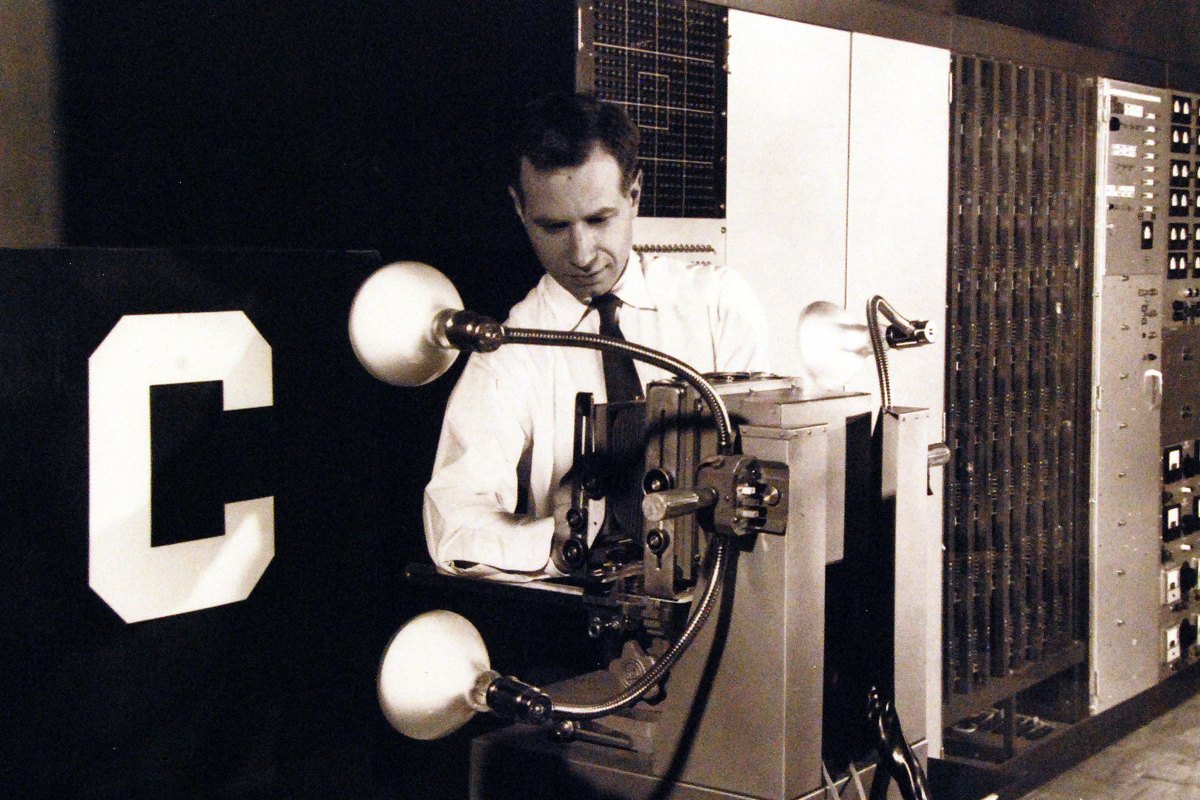
On 8 July 1958, on page 25 of The New York Times, a UPI wire story ran under a modest headline: “New Navy Device Learns By Doing.” The first paragraph was far less modest.
“The Navy revealed the embryo of an electronic computer today that it expects will be able to walk, talk, see, write, reproduce itself and be conscious of its existence.”
The demonstration shown to reporters that day was smaller. A Weather Bureau IBM 704 learned to tell a card marked on the left from a card marked on the right. It needed about fifty attempts.
I reread that article often. It sounds a lot like the announcements I read every week in 2026.
Frank Rosenblatt and the perceptron
Behind the story was Frank Rosenblatt, a research psychologist at the Cornell Aeronautical Laboratory in Buffalo. The same year he published “The Perceptron: A Probabilistic Model for Information Storage and Organization in the Brain” in Psychological Review. He described “a hypothetical nervous system, or machine, called a perceptron.”
The idea fits in one sentence. Randomly connected units can learn to associate a response with a stimulus, provided their connections are corrected when they get it wrong. No hand-written rules. Weights that move with experience.
The Mark I: a machine, not a simulation
The project, funded by the Office of Naval Research, produced a physical machine: the Mark I Perceptron. Its operators’ manual, dated 15 February 1960, describes it precisely:
- An “eye”: 400 photoresistors mounted in a 20 × 20 grid in a modified view camera.
- 512 association units, wired to the eye through a large plugboard.
- 8 response units, showing what the machine thinks it sees.
- Mechanical weights: potentiometers turned by small electric motors.
How it learns
- A letter is placed in front of the eye.
- Each lit cell sends a signal, weighted by a potentiometer.
- The machine adds up the signals and gives an answer.
- If it is wrong, the operator forces the right answer. The weights adjust.
The Navy’s June 1960 release puts it plainly: when the machine misidentifies a letter, “the trainer forces it to respond correctly by means of an electrical control.” Supervised learning, with a human and a switch.
What the machine actually did
The Mark I learned to recognise letters. That was real, and remarkable for its time. But Rosenblatt himself, in “Principles of Neurodynamics” (1961), was precise about the limits:
- The full alphabet, shown in a fixed position, represented “about the limit of the capacity of the Mark I system.”
- With two typefaces at once, attempts failed, “the maximum performance being about 85% on the combined alphabets.”
- On a task that hard, moving a letter away from the position where it was learned was likely to wipe out the correct response.
As early as his 1958 paper, he wrote that recognising relationships in space and time “seems to represent a limit to the perceptron's ability to form cognitive abstractions.” The researcher knew the bounds of his prototype. The headline talked about consciousness.
1969: the limits proven, then the winter
In 1969 Marvin Minsky and Seymour Papert published “Perceptrons” with MIT Press. They analysed the single-layer perceptron mathematically and showed that some problems that look simple, such as parity or whether a figure is connected, stay out of its reach as the image grows.
The sociologist Mikel Olazaran, who studied the controversy, describes what followed: neural networks, popular in the late 1950s, were almost abandoned in the second half of the 1960s. Funding moved to symbolic AI. The field only really came back some twenty years later. Rosenblatt did not see it: he drowned in 1971, on his 43rd birthday.
The link with today’s LLMs
The limit proven in 1969 applied to a single learning layer. That was the Mark I: only the connections between association units and response units could be adjusted. The answer came later: stack the layers, and find a way to correct the weights of all of them at once.
An LLM is built on that principle. In the Transformer architecture, described in 2017 in “Attention Is All You Need,” every layer contains a fully connected network: weighted sums followed by an activation function. The layers are stacked. Training still means measuring the error and adjusting the weights to reduce it.
There are real differences, of course: the attention mechanism, the scale, how the corrections are computed. But the basic unit, a weighted sum whose weights adjust after an error, comes straight from 1958. The idea held. The promise had to wait.
What this means for an organisation
The perceptron story is not a story of fraud. The researcher was honest about the limits, the machine worked, and the idea was right. The problem was the gap between the headline and the prototype. That gap still exists.
When a small or mid-sized company evaluates an AI tool, I advise separating three things:
- Scope. Which precise task, at what volume, with what data? “It will do everything” is not a scope.
- Measurement. A success rate measured on your real cases, this quarter. Not on the vendor’s demo, not on the roadmap.
- A business owner. Someone who knows the work, judges the errors and decides whether the tool goes into production.
The Mark I would have passed that test for one alphabet in a fixed position. It would have failed it for two mixed typefaces. Both facts were on record by 1961. Those are the facts to look for before you buy. I cover this step from demo to real use in why AI proofs of concept stall before production.
Buy on what the tool does on your data this quarter. Not on what the press release says it will do.
Primary source: F. Rosenblatt, “The Perceptron: A Probabilistic Model for Information Storage and Organization in the Brain,” Psychological Review, vol. 65, no. 6, 1958, pp. 386-408.
In the same series
The other episodes of “the ancestors of LLMs”, in chronological order:
- Ada Lovelace, 1843: the engine “originates nothing”
- Markov, 1913: Pushkin letter by letter
- Shannon, 1948: a book opened at random
- Turing, 1950: the test, and the wrong question
- Dartmouth, 1956: the first underestimated AI quote
- ELIZA, 1966: a machine that understands nothing
- Jelinek, 1980s: statistics beat grammar
- Asimov, 1991: two intelligences, not one
Frequently asked questions
What is Rosenblatt’s perceptron?
A model of an artificial neuron published by Frank Rosenblatt in 1958 in Psychological Review: randomly connected units that learn to associate a response with a stimulus by correcting their weights after each error. The Mark I Perceptron was the hardware version, with 400 photoresistors in a 20 × 20 grid.
Why was the perceptron abandoned after 1969?
In “Perceptrons” (1969), Minsky and Papert proved the limits of the single-layer perceptron mathematically, for example on parity or connectedness. According to the sociologist Mikel Olazaran, funding then moved to symbolic AI, and neural networks only really came back some twenty years later.
How is the perceptron linked to LLMs?
An LLM stacks many layers of weighted sums followed by an activation function, with weights adjusted to reduce error. That is the perceptron’s basic unit, in many layers and at a vastly larger scale, plus the attention mechanism.