You don’t need to be in tech to have an AI harness
An AI harness is mostly text: rules, a memory and a few checks. Six examples of professions outside tech where it is useful to have one that is well set up.
Most of the AI harnesses people talk about online are written by developers, to write code. You might think the subject belongs to people in tech. I think it is even more useful to lawyers, accountants, doctors, estate agents, tradespeople and restaurateurs.
The model (Claude, ChatGPT, Gemini) is the engine. The harness is everything you put around it: the rules it reads at every session, the memory it keeps, the tools it can reach and the checks its work must pass before it goes out. I described mine in detail. Most of it is text written in everyday language. Two words come up in the diagrams in this article: a skill is a written procedure the AI reuses, stored with its templates and reference documents, and MCP is the standard that connects the AI to your tools.
According to the France Num 2026 barometer, 40% of French small businesses (TPE and PME) now use AI tools, 14 points more than a year ago. Among lawyers, the Ifop barometer for the Conseil national des barreaux, the French national bar council, gives 93% of lawyers as users, 70% of them several times a week. Most of the time, everyone uses their own tool on their own, with no shared rules.
In a regulated profession, the rules are already written
When I built my harness, I had to invent my rules, one mistake after another. In a regulated profession, the professional body, the law and the inspection services have already written what to do and what is forbidden. What is left is to put these rules in a file the AI reads at every session, and to lock the few that must never be broken.
For each of the six professions below, I give what the AI can take on, the rule the harness must carry, and the check to run before a document is sent.
Six examples
The law firm
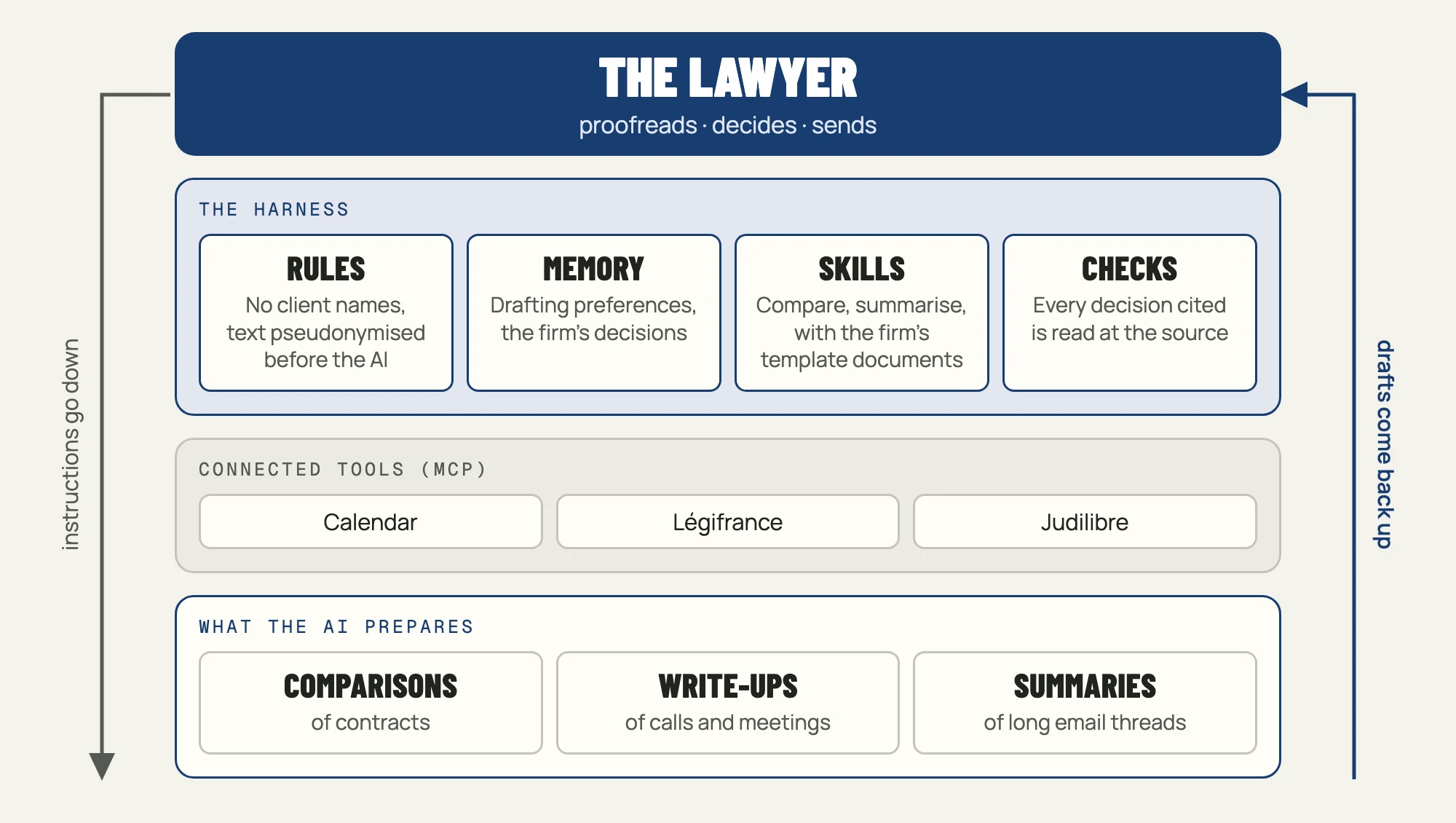
The Conseil national des barreaux guide to generative AI lists several uses: comparing two versions of a contract, writing up a meeting or a call, summarising a long email thread.
The rule to carry is professional secrecy, which the national internal regulations of the French bar describe as “general, absolute and unlimited in time”. The same guide says a lawyer must “never communicate data covered by professional secrecy to generative artificial intelligence”, and recommends replacing client names with fictitious initials. In a harness, this becomes a written rule and a fixed step: the text is pseudonymised before it is handed to the AI.
The check is on sources. Every court decision cited in a draft is opened and read before the document leaves. The database kept by the researcher Damien Charlotin lists 2,292 decisions worldwide where an AI invented references, 14 of them in France. In December 2025, the administrative court of Orléans reminded a lawyer of “the need to check the court decisions cited”.
The accountancy firm
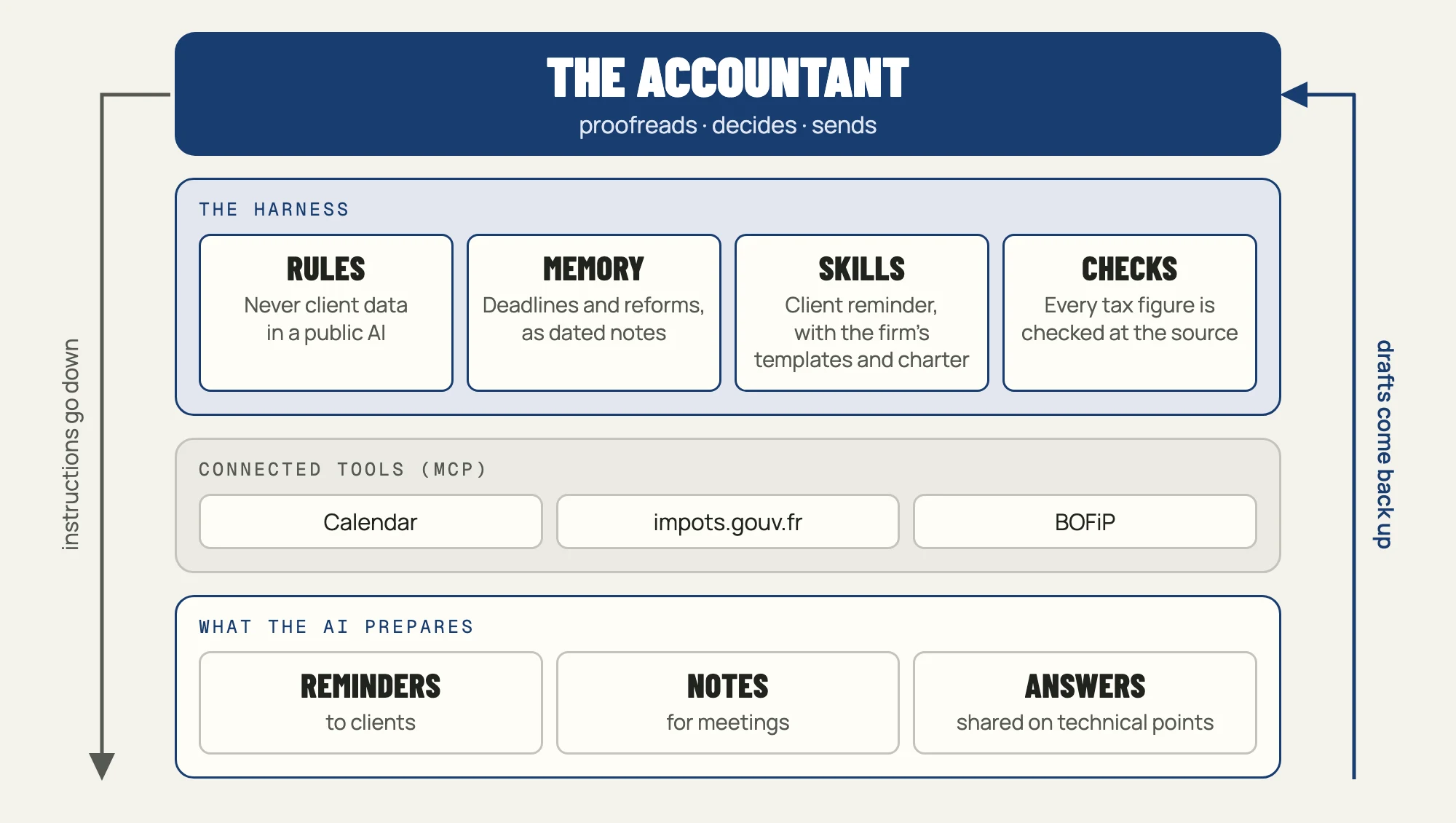
The white paper of the Ordre des experts-comptables d’Île-de-France, the Paris-region chartered accountants’ body, gives other examples: rewriting a client reminder written in the heat of the moment, preparing the notes for a meeting, giving the whole team the same answer to a technical question.
Professional secrecy is set by article 21 of the 1945 ordinance that governs the profession in France. The white paper proposes a model charter in three lines: “Never client data in public AIs”, “Always anonymise before use”, “Always check the information generated”. These three lines can be copied as they are into a rules file.
Memory is for the rules that change. A firm answers the same questions all year. Take e-invoicing: since 1 September 2026, all businesses in France must be able to receive electronic invoices, and SMEs and micro-businesses will have to issue them from 1 September 2027, according to impots.gouv.fr. A dated note in the memory, with its source, stops the AI answering from recall. Every tax figure is then checked at the source before it is sent to a client.
The medical practice
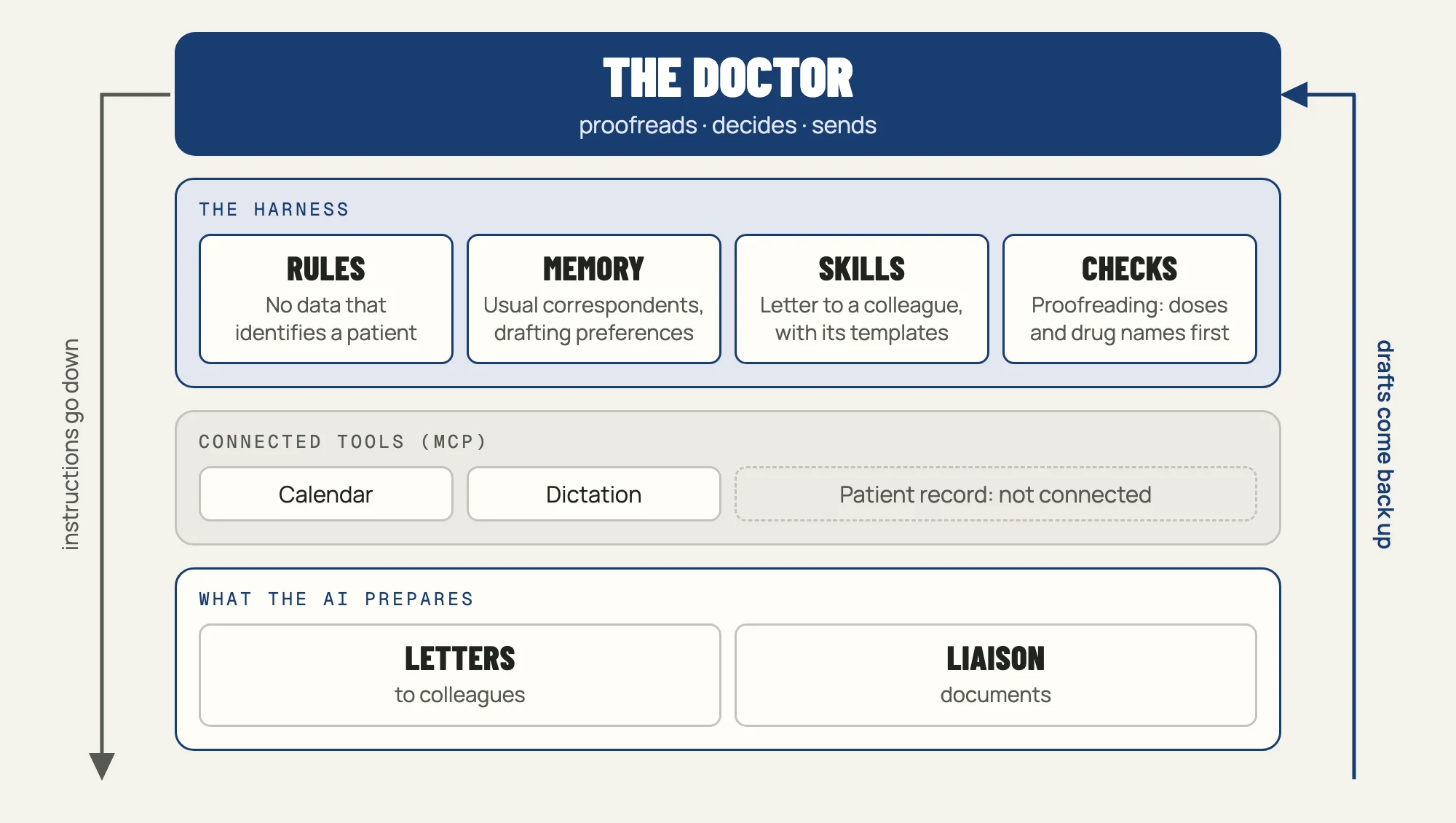
The Haute Autorité de santé (HAS), France’s national health authority, lists writing liaison documents, such as a letter to a colleague, among the uses of generative AI, in its guide “Premières clefs d’usage de l’IA générative en santé” (“First keys to using generative AI in healthcare”).
The rule entered the French code of medical ethics in 2026. Since 30 July 2026, article R4127-13-1 of the French public health code requires a doctor who uses AI to take “the essential precautions” to guarantee the security and confidentiality of health data. The HAS asks doctors to check that no information that identifies a patient or falls under medical secrecy is shared with a tool that has no confidentiality guarantee. Health data must be hosted with a certified host.
The simplest lock is to leave the AI unconnected to the patient record. It works on the text the doctor chooses to give it, with no name or date of birth. The check is a proofread that starts with doses and drug names. The HAS gives the example of an “mg/dose” that became “µg/dose”.
The estate agency
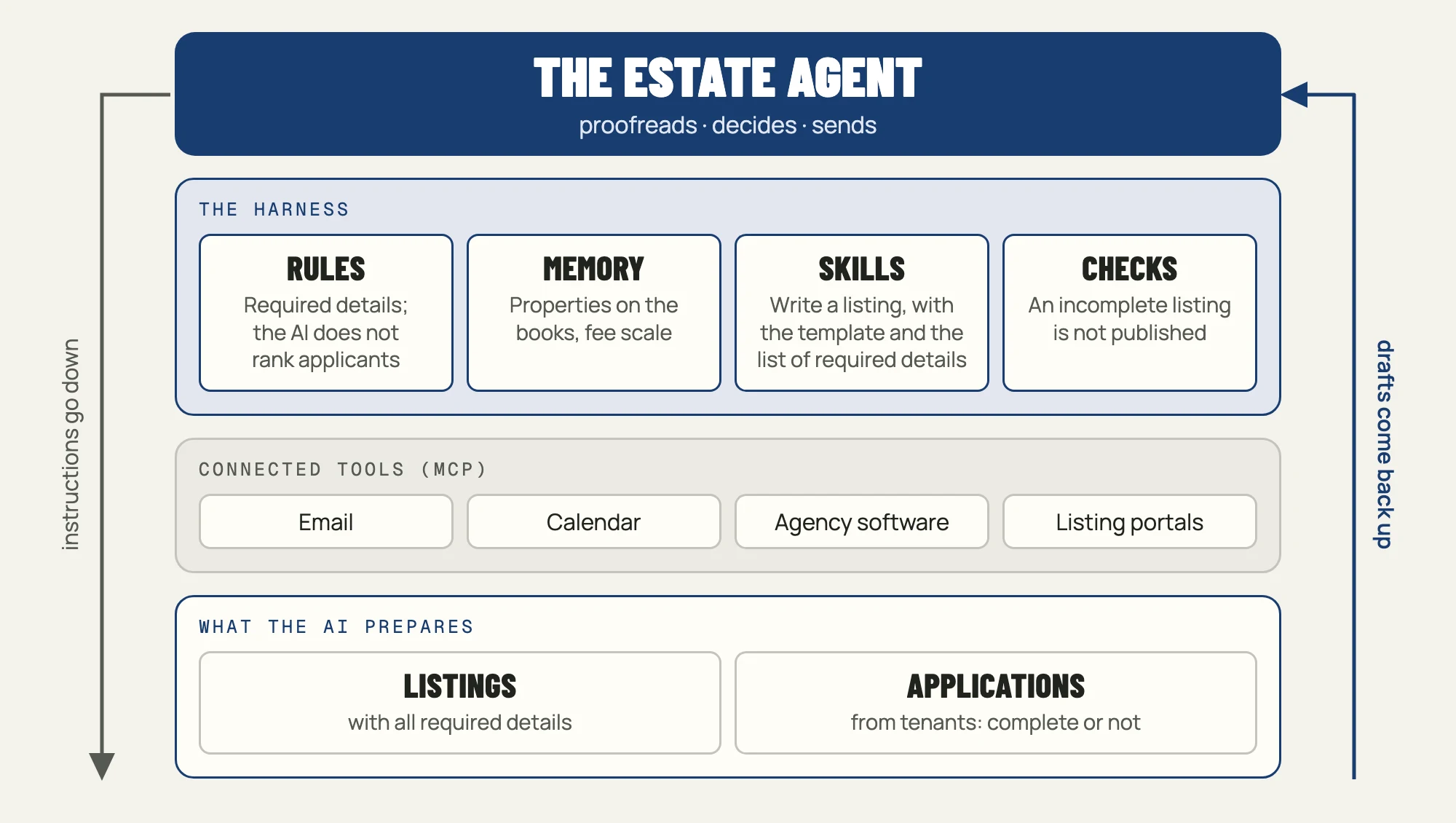
An agency publishes listings all week, and each one must carry precise details: the fees and who pays them, the floor area, the service charges, the deposit, the classes of the energy performance certificate (DPE). In its 2023 investigation, the DGCCRF, France’s consumer protection authority, found at least one anomaly at 65.1% of the 1,739 professionals inspected.
The harness holds the list of required details, and a check runs every listing through it before publication. If the energy certificate is missing, the listing does not go out. The check no longer depends on the memory of whoever is publishing that day.
The red line concerns tenant applicants. The list of documents you may ask them for is set by decree in France, and refusing a rental on discriminatory grounds is punishable by three years in prison and a €45,000 fine. In the harness, the AI checks that an application is complete against the official list. It does not rank the applicants.
The building tradesperson
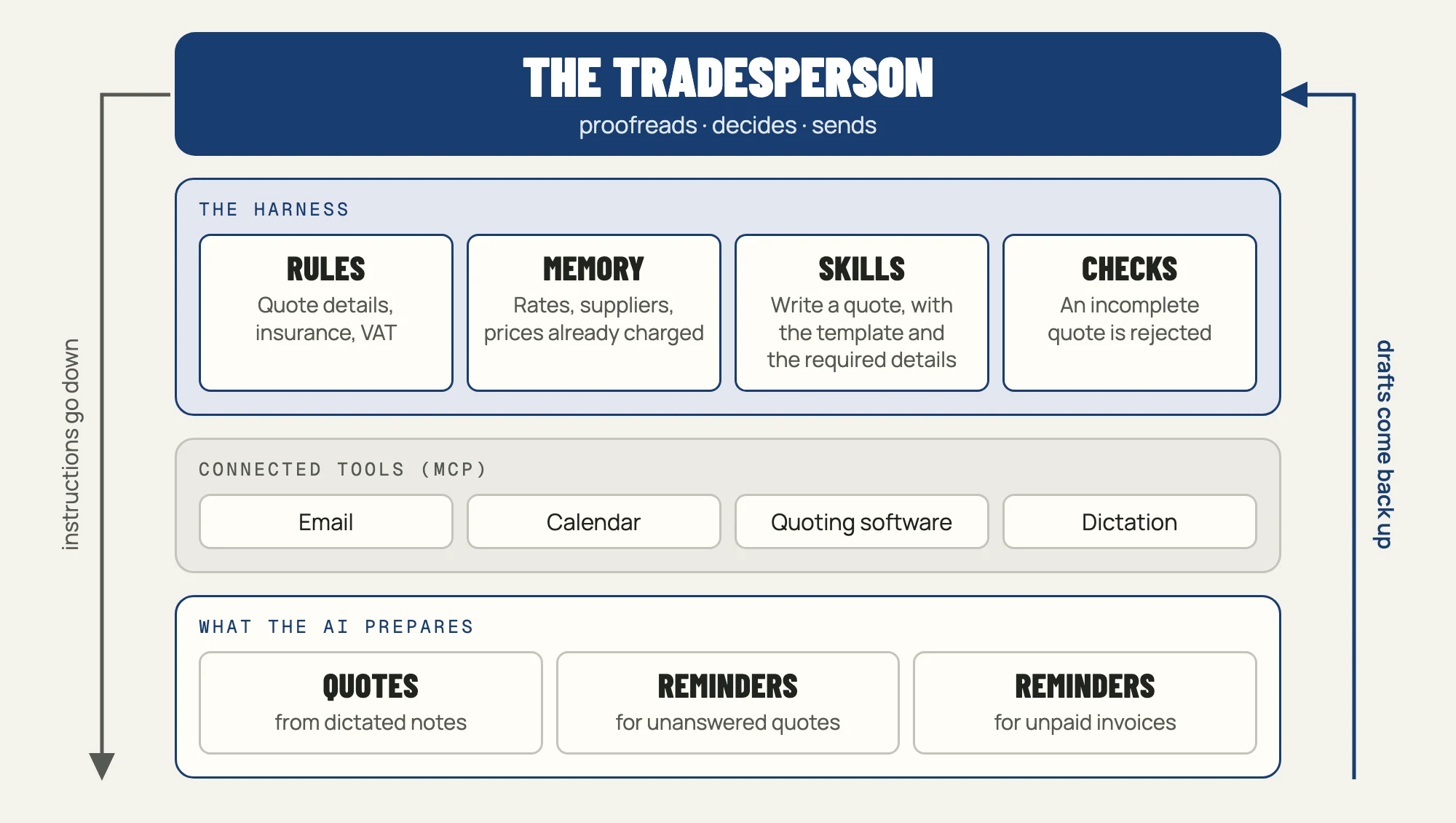
A tradesperson often writes quotes in the evening, after the site. The AI can write the quote from a few dictated notes, chase the quotes that stay unanswered and chase unpaid invoices.
For emergency and repair work at the customer’s home, the ministerial order of 24 January 2017 sets what a quote must contain: the exact nature of the work, a detailed breakdown by quantity and price, the total before tax and including all taxes with the VAT rate, the validity period of the offer, and whether the quote is paid or free. Professional insurance and the insurer’s contact details are added to this. The reduced VAT rate, 10% or 5.5%, applies only to a home completed more than two years ago, which the customer certifies on the quote or invoice.
In the harness, these details are a template, and a check rejects any incomplete quote. The memory keeps the rates, the suppliers and the prices already charged. The tradesperson proofreads and sends. In home emergency repairs, the DGCCRF found anomalies at nearly 64% of the businesses inspected.
The restaurant
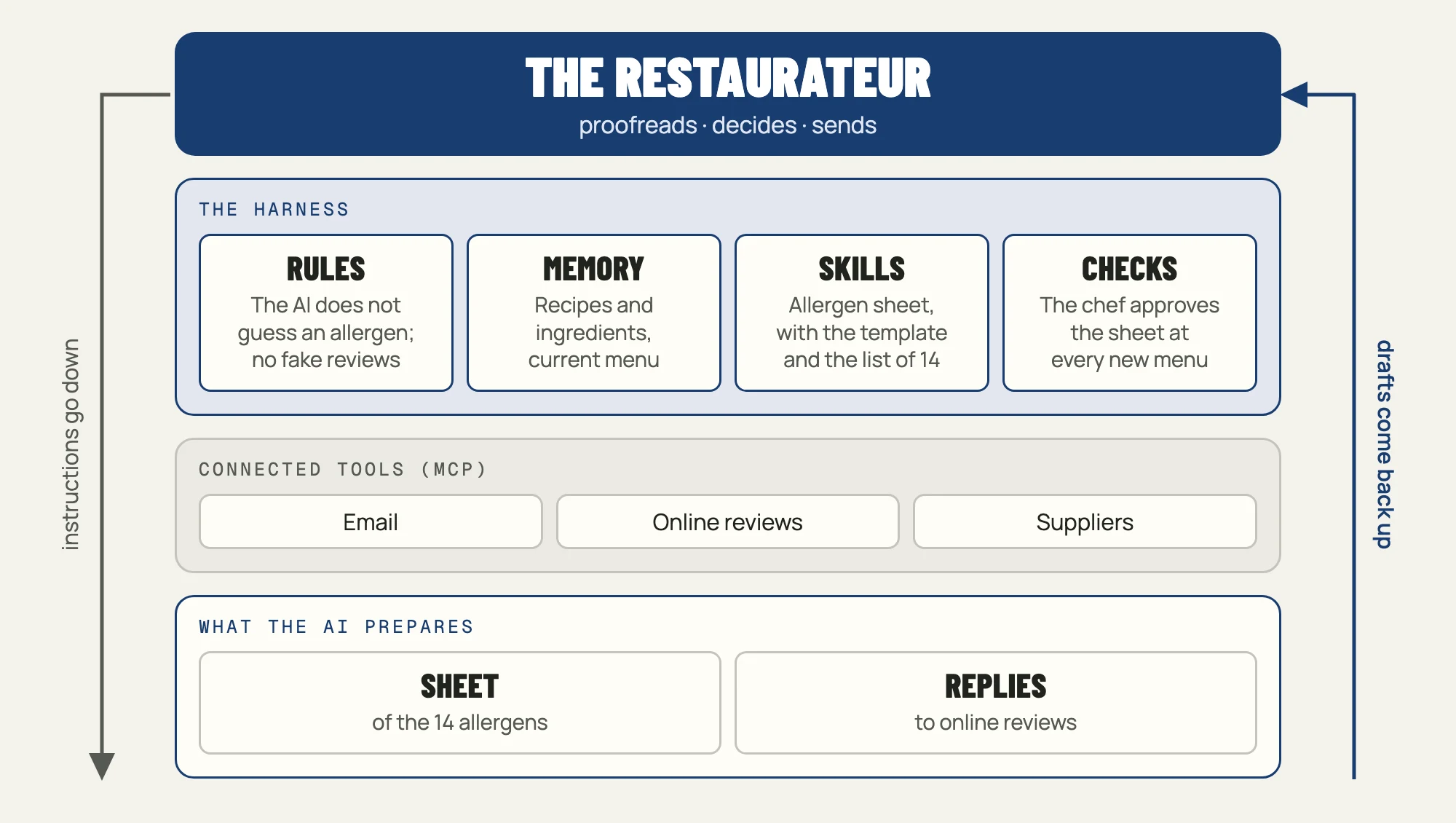
A restaurant must inform its customers in writing, legibly and visibly, of the presence of 14 allergens. The sheet has to follow every change of menu, and it soon falls behind. In 2023, the DGCCRF inspected 646 businesses that deliver meals: 21% were in breach, and allergen information was often missing.
The harness keeps the recipes in memory. At every new menu, the AI redoes the sheet from the recipes, and the chef approves it. The written rule forbids the AI from guessing an allergen. If an ingredient is missing from a recipe, it asks.
For online reviews, the AI writes the replies to customer reviews. It does not write reviews. Publishing fake reviews is a misleading commercial practice, punishable by two years in prison and a €300,000 fine.
What these six harnesses have in common
None of these professions needs to invent its rules. They existed before AI, and it is enough to gather them in a file the AI reads at every session.
The rules to lock are much the same everywhere: confidential data does not leave the firm, no document goes out without proofreading, and the AI takes no decision about a person.
In all six cases, the AI prepares the document, checks the required details and flags what is missing. The person who signs decides whether to send it.
Where to start
A workspace with instructions and a few files, like the projects in Claude or ChatGPT, is enough to start, with no terminal and no developer. First check the privacy terms of the plan you use.
- Write on one page what the AI must never receive, and what it must never send on its own.
- Add the texts of your profession: your professional body’s charter, the mandatory details of your documents.
- For each document that goes out, write the checklist it must pass.
- Keep a lessons file. Every time the AI gets something wrong, add a line.
The next steps, with connected tools and scheduled tasks, are in the six steps of my own harness.
I am not a lawyer, a doctor or an accountant. The texts quoted are current as of 14 November 2026, and your professional body or organisation remains the reference for your profession.