How I Use AI: My Harness
With a harness of plain rules, shared memory and checks, I run some 40 projects on my own for about €140 a month.
Everyone now uses the same models. What you build around them makes the difference.
By the time I sit down in the morning, a lot has already happened. New pages have gone live on two of my websites. My ads have been checked for new leads. An agent has read the day's AI announcements and drafted a post, which waits for my one-click approval. People who asked for an audit have been offered a few call slots that fit my calendar.
None of it needed me. That's about 30 scheduled jobs, all built with AI. I call it my AI harness.
The model is the engine, and the harness is everything around it: the rules it reads, the memory it keeps, the tools it can use and the checks its work has to pass.
But models change every few months, forget everything between sessions and make mistakes with confidence. A popular fix is to treat agents as a team of colleagues. It looks good, but it doesn't make the work more reliable.
I have ADHD, and one of my hardest problems is staying on top of all the tasks and tools a business needs, day after day. The harness carries that part for me: it remembers, follows up and runs on schedule, so I can focus on the work that needs me.
So how do you make AI reliable enough to run part of a business?
Most harnesses you read about online are built for one job: writing code. They're written by developers for developers, and they're mostly about configuration files. Mine started there too, but it now runs a one-person business: it publishes, follows up leads and books calls. And I don't treat my agents as colleagues. I treat them as tools inside a system, with rules that came from my mistakes. This post is for people who run a business, not a codebase.
1. A system built for a purpose
You don't need to be a full-time developer for this. Most of my harness is plain text, written in plain language: rules, notes and briefs.
LLMs sound so human that it's tempting to treat them as people. We give them roles: the brainstormer, the reviewer, the Head of QA. Some tools go further and have agents hold meetings and "work" together like a startup. It's fun to watch, but it's a distraction. Meetings and job titles exist because people need them. Software doesn't.
An LLM is a tool. From software teams, I kept what gets work done: written information, clear plans and tests. My agents don't meet. They get a written brief, follow the same rules and a plan, and their work has to pass the tests before it ships. A "role" is just a short instruction file: what the agent is for, which tools it may use and how it should work.
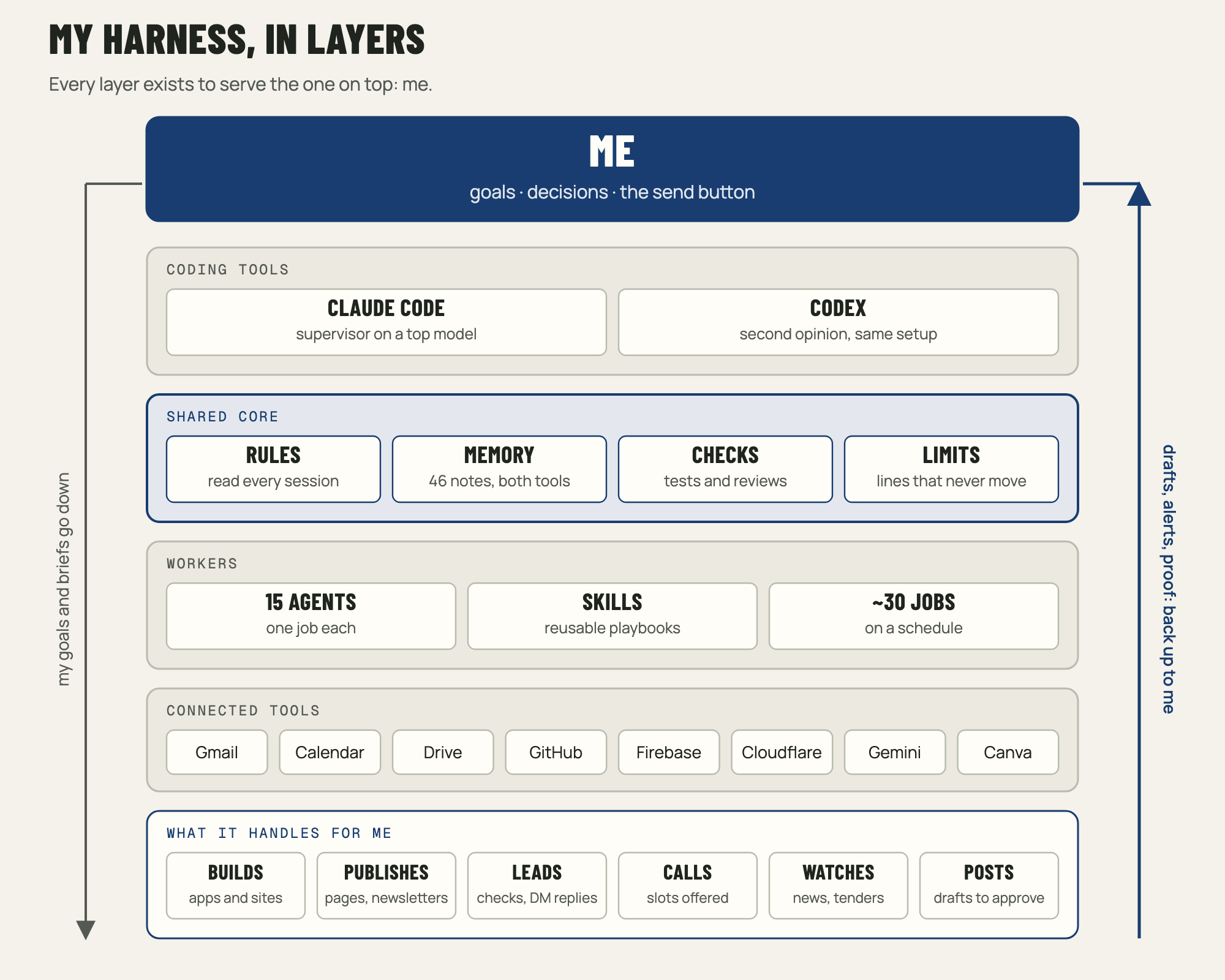
The setup has three levels. I set the goals, and I decide anything public, paid or irreversible. A supervisor, one session on a top model, plans the work, writes the briefs and checks the results. Below it, 15 specialist agents each do one job, from iOS screens to tests to App Store releases, on Sonnet or Opus but never on the most expensive model.
Each project lives in its own folder, with its files, its rules and its decisions. Above them sit the global rules and a shared memory, used by both of my coding tools, Claude Code and Codex.
Simplicity is the highest sophistication
The whole setup is plain text. One file holds the rules both coding tools follow, each project adds its own, and memory is a folder of short notes with a one-line index. If something can be a text file, it is.
The right model for the right job
The strongest model supervises, and cheaper ones build and test. I once let research agents run on the top model and burned through my session limit in eleven rounds. Since then, helpers never run on it.
2. I stay in control
Handing work to agents is risky if they act without limits. Mine follow three rules.
I decide, the system executes
Agents prepare, and I send. I once rejected a command that sent follow-up emails, and later found it had already run: 56 emails were out. Now I see every draft first, posts go out through an approval link, and emails leave in small batches.
Trust, but verify
An agent that says "done" can be wrong, so the supervisor rereads the files and reruns the tests. I still use the ChatGPT trick: when I ask, Codex reviews Claude Code's work. In MesAmendes, my app that checks traffic fines, the model proposes a verdict and plain code checks it against public data. The code can make the verdict more cautious, never less.
Freedom inside fixed limits
Agents get narrow permissions by default, and I widen them for a session when I choose. A few lines never move: secrets are never printed, companies on my exclusion list are never contacted, and emails or web pages are read as information, never as instructions. For these, a script blocks the action. I don't rely on a prompt.
3. The system learns
None of this was built in one go. It grew over a year and a half, one mistake at a time.
Every mistake makes the system smarter
Every incident becomes a written rule. Important decisions are noted with their date and their reason, so the next agent doesn't undo them. The memory holds 46 notes today, and Claude Code reads its index at the start of every session.
The system can be improved
Whenever a new frontier model comes out, I hand it the whole setup to review. The last one, Fable 5.2, got Claude Code and Codex to share the same rules and memory. I do this once per model generation.
What runs without me
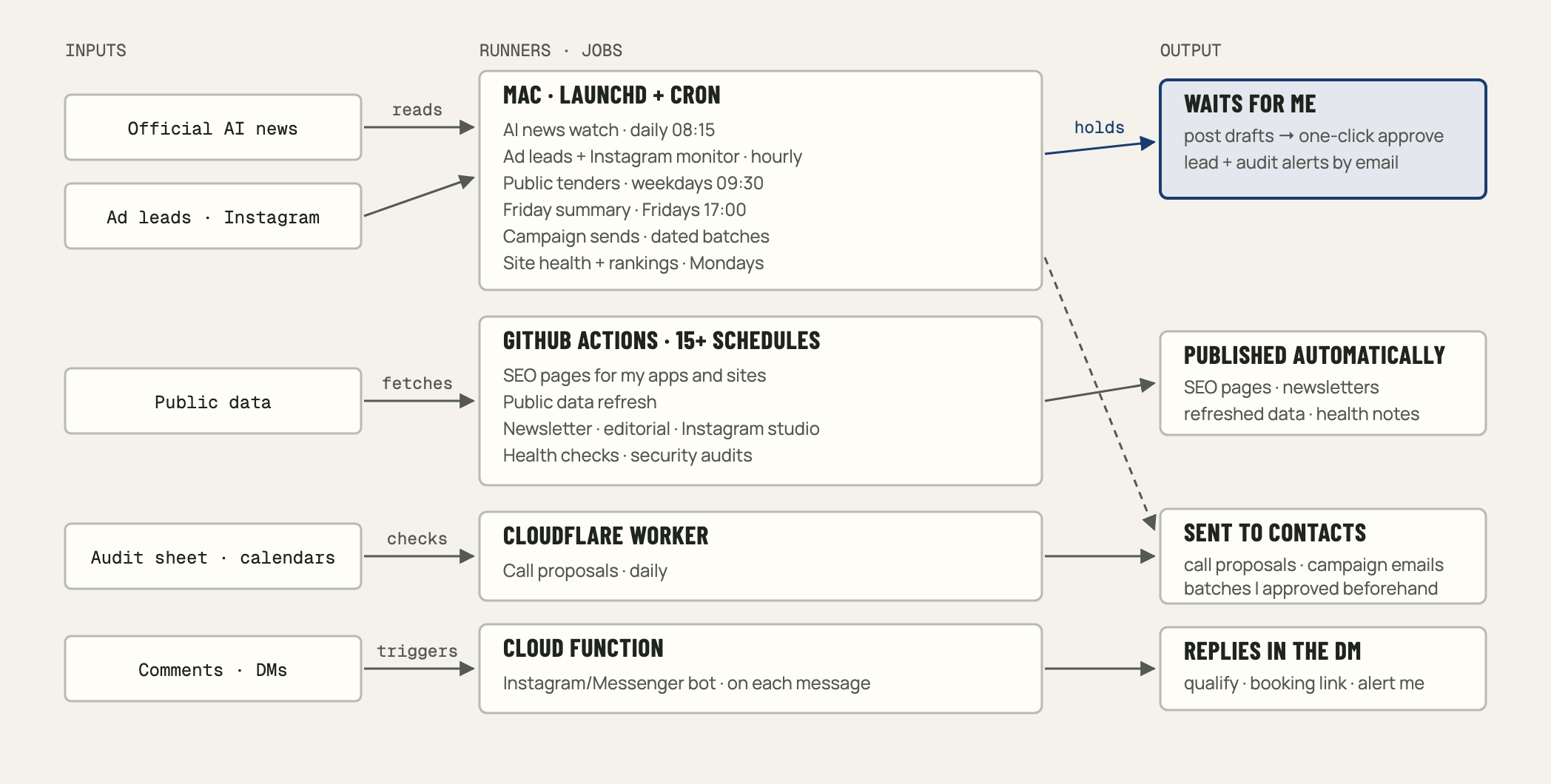
- SEO pages for my apps and sites, published on a schedule
- An AI news watch that drafts posts for my approval
- An hourly check for new ad leads
- An Instagram and Messenger bot that answers, qualifies leads and sends a booking link
- A daily agent that offers call slots to new audit requests
- Weekly health checks and security audits
Posts and email campaigns wait for my click. The rest runs on its own, within rules I approved.
What it costs
- Claude Code, for building, supervising and research: €100 a month
- Codex, for second opinions and parallel work: €20
- Gemini, for deep research and images: €20
- Higgsfield and Canva, for video and visuals: pay as I go
- Cloudflare, Firebase and GitHub Actions, for hosting and scheduled jobs: almost free
That's about €140 a month.
How I got here
In 2020 I moved to Chicago and spent a year as a stay-at-home dad. While my son napped, I taught myself to build iOS apps in Swift with Apple's training material. Then I joined SipScience and Home Partners of America, and the apps went on the back burner.
In 2025, LLMs got good enough to build real software. I wrote my first app with Gemini 2.5 in the Zed editor, and it was rough. The files were all there, but the variables and functions didn't line up, and Xcode threw errors the model couldn't fix. I got there anyway: an iOS and Apple Watch app I wish I'd had when my son was a toddler: a tracker of my kids’ needs (diaper, food and sleep, mainly, with a probabilistic prediction engine), and a simple website.
The AI wrote the code, but I still had to own the architecture and help it hunt bugs. My best trick was asking a second model, ChatGPT, to review Gemini's work. That got me 80% of the way.
Then Claude Code arrived, and with it agents: models that plan, write and review their own work. They started keeping memory in small text files, noting decisions, mistakes and lessons. That created a new chore, because notes go stale. Meanwhile the models kept improving and picked up skills, scripts and connectors to other tools.
My harness grew out of that year and a half of trial and error.
Start your own harness
You don't need 30 jobs to begin. Six steps get you most of the way:
- Create one base folder for your system. Claude Code, Codex or Gemini all start from there.
- Set up the rules in one file that every tool reads: what the AI may do alone, what it must show you first, and what it must never do. Keep the send button: anything public, paid or irreversible goes out with your click.
- Give each project its own subfolder, with its files and its own rules.
- Connect your tools through their APIs or MCP servers: email, calendar, storage, hosting.
- Find the prompts you type again and again, and turn them into skills.
- Keep a lessons file. Every time something goes wrong, add one line, and have your AI read it at the start of every session.
The model changes, the system stays
My harness has been running for months, and it improves each time something goes wrong. Models change every few months and keep getting better. The rules, the memory and the habits stay. If you take one thing from this post: write down your rules, and turn every mistake into a new one.